
Vyora’s Injection Guide
Simple, step‑by‑step instructions for safe, confident at‑home subcutaneous (SubQ) injections.
Always follow your prescription label and your clinician’s instructions. If there’s ever a mismatch between this guide and what your clinician told you, always go with your clinician.
Quick Prep (1–2 minutes)
- Wash/sanitize hands; use a clean, well‑lit surface.
- Confirm medication name, dose, and expiration date.
- Gather: vial, new syringe/needle (or pen needle) and alcohol swabs.
- Choose an injection site and plan to rotate sites.
Do not share or reuse needles.
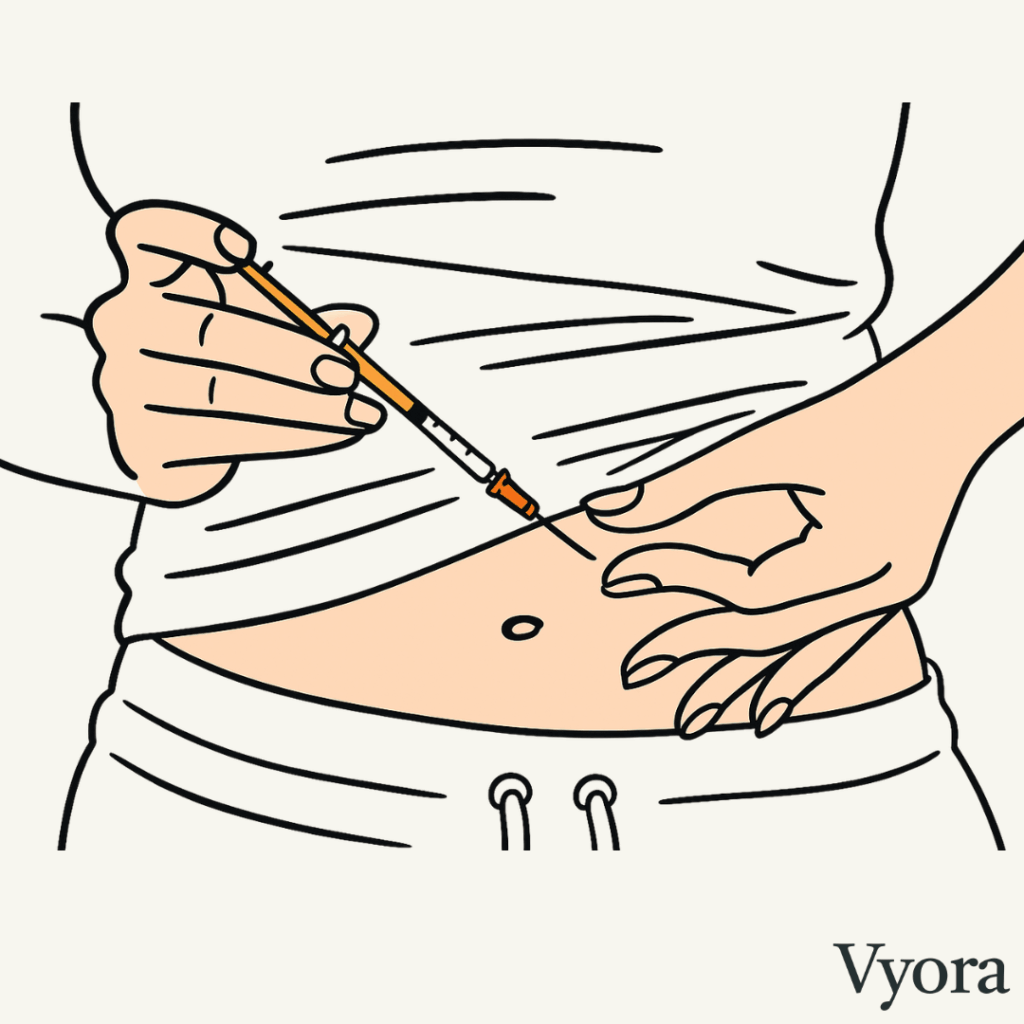
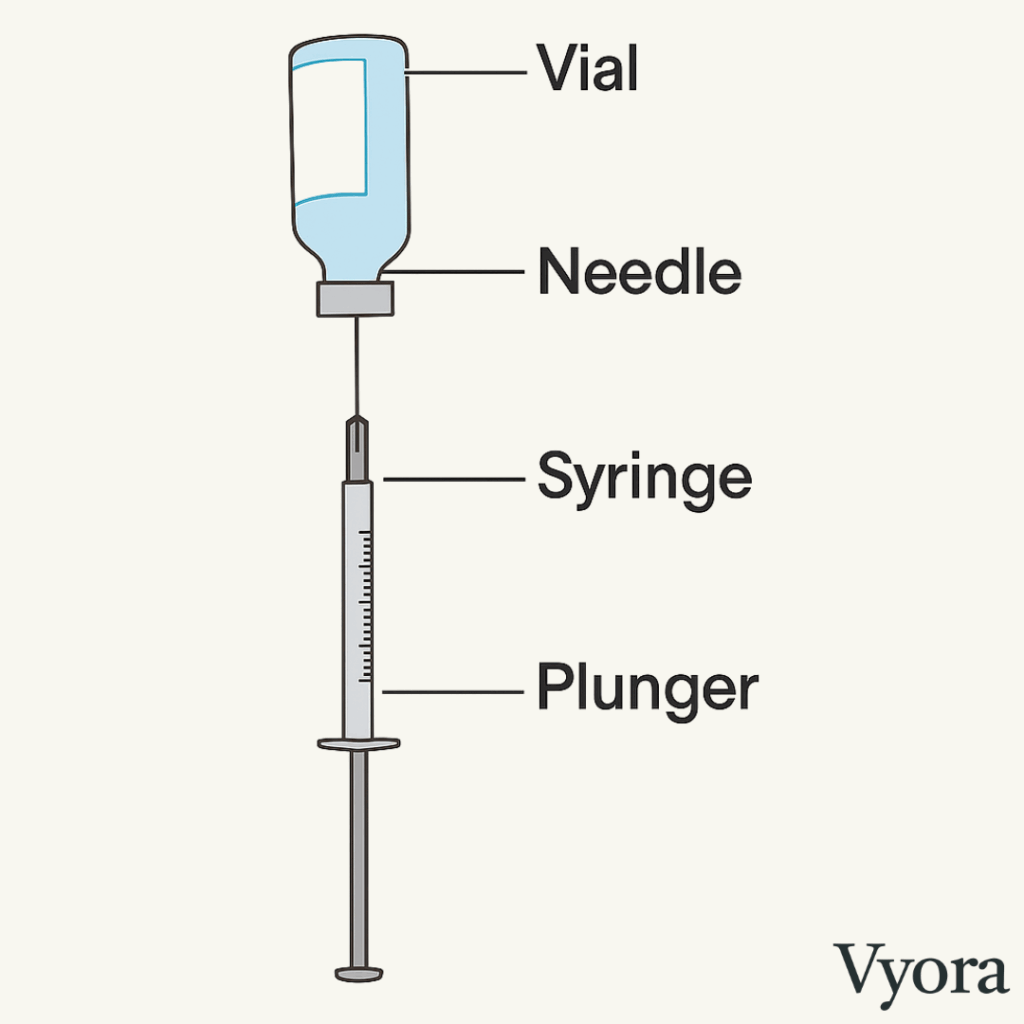
How to Give a SubQ Injection (6 steps)
- Clean
Wipe the vial’s rubber stopper and your skin at the chosen site (abdomen, outer thigh, or back of upper arm). Let alcohol air‑dry. - Draw the dose
Attach a new needle. Pull air into the syringe equal to your dose. Insert into vial, push the air in, then invert and draw to the exact dose line. Flick to move bubbles up and adjust as needed. - Pinch
Pinch 1–2 inches of fatty tissue between thumb and forefinger. - Insert
Insert the needle quickly and smoothly at 45–90° (your clinician may specify the angle based on needle length/body type). - Inject
Press the plunger slowly and steadily until all medication is delivered.
Site Rotation (quick guide)
- Abdomen: at least 2 inches away from the navel; avoid scars/bruises.
- Outer thigh or back of upper arm (if someone else is helping).
- Rotate to a new spot each time to reduce irritation.

Intramuscular Injection (IM) — Overview
Some medications may be prescribed to be administered intramuscularly (IM) rather than subcutaneously. Intramuscular injections deliver medication directly into muscle tissue, where it can be absorbed efficiently.
Only use this method if your provider has specifically instructed you to do so.
For patients transitioning from subcutaneous injections, the medication itself remains the same. The primary difference is the needle setup, which may involve using one needle to draw up the medication and a separate needle for the injection. While this can feel overwhelming at first, it is a common and safe practice when performed as instructed by your provider or care team.
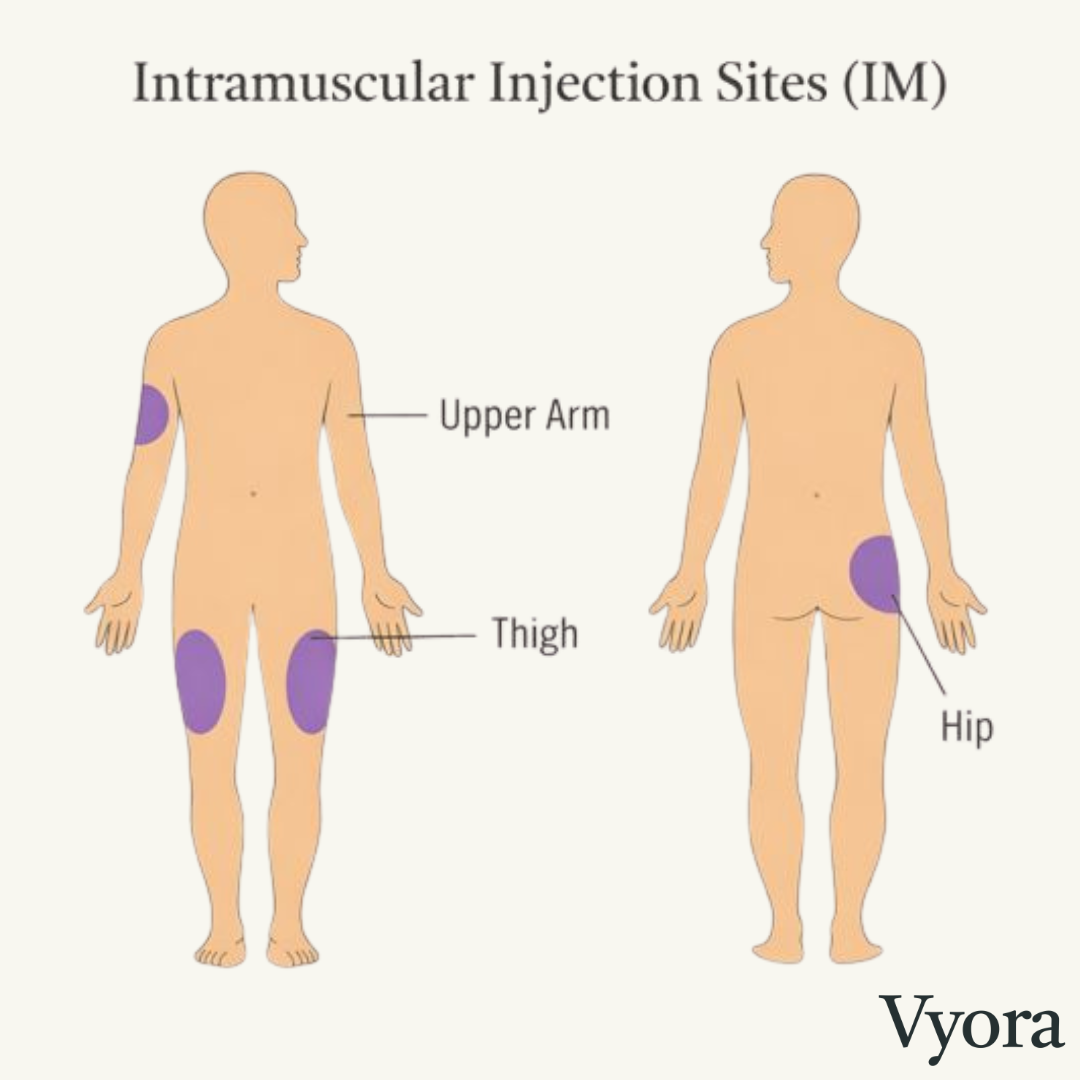
Common Intramuscular Injection Sites
Intramuscular injections are typically administered in one of the following areas:
- Upper arm (Deltoid muscle) Located on the outer portion of the upper arm, about 2–3 finger widths below the shoulder. Commonly used for smaller-volume injections.
- Outer thigh (Vastus lateralis muscle) Located on the outer middle portion of the thigh, between the hip and knee. This is one of the safest and most accessible sites for self-administration.
- Hip (Ventrogluteal muscle) – Located on the side of the hip, slightly above and forward of the buttock. Often preferred by clinicians due to lower risk of nerve or blood vessel injury.
Note: The upper outer buttock (dorsogluteal site) is less commonly recommended today due to proximity to the sciatic nerve.
If you are unsure whether your medication is intended for intramuscular versus subcutaneous use, or if technique is unclear, please confirm with your provider before administering.
Storage & Handling
- Follow your label. If instructed to refrigerate, do not freeze.
- Keep away from heat, light, and moisture.
- Store out of reach of children and pets.
Missed Dose
- Follow the instructions on your prescription, or message the Vyora clinical team before changing timing or doubling doses.
When to Contact a Clinician
- Increasing redness/warmth, swelling, or drainage at the site
- Severe pain, numbness, or a rash/hives
- Trouble breathing or signs of allergy—seek emergency care
- Any question about dose, timing, or technique
Contact us via Clinical Chat in your Vyora portal, or email support@vyorawellness.com for order/shipping help.
How To Read Your Syringe:
A Quick Guide For PEPTIDES + GLP-1s
If you’re new to peptide or GLP-1 injections, this is for you.
Reading your syringe correctly is really important, and it’s actually very simple once you know what to look for!
Step 1: Check your PRESCRIPTION BOTTLE
This is the bottle from the pharmacy with your name on it, of which houses the actual product, not the small vial of medication.
Your prescription label tells you exactly how many units to inject.
For example:
“Inject 20 units of Sermorelin nightly”
Step 2: Match that number to your SYRINGE
Your syringe is already labeled in units.
No conversions or extra math. Just pull the plunger to the correct line.
Examples:
20 units = fill to the 20 line
30 units = fill to the 30 line
50 units = fill to the 50 line
25 units? Just fill halfway between 20 and 30.
Done!
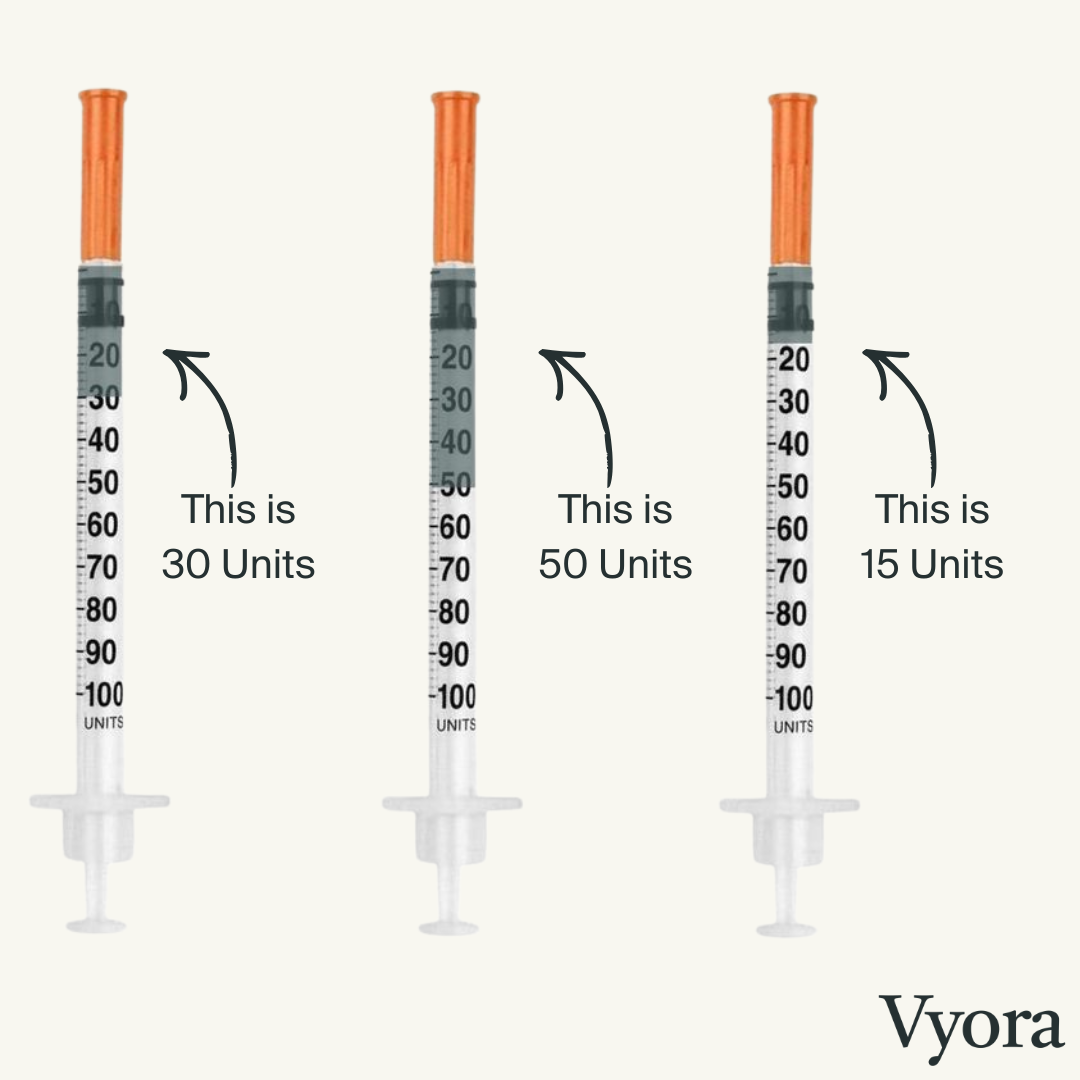
Common Mistake
Some people accidentally fill the syringe all the way to the 100 line, thinking they need to use all of it.
Please only go to the 100 mark if your prescription says inject 100 units.
That is a full syringe, and it’s rarely the correct dose.
Always store your peptide in the prescription bottle, not just the vial. It keeps it clean, labeled, and ready to use.
Pro Tip
Keep your medication vile INSIDE the actual prescription bottle it’s your guide for how many units to inject. It also keeps your vile clean!
If you’re ever unsure, take a photo of your prescription and syringe and reach out to our team.
We’re here to help: support@vyorawellness.com
A Quick Note About Units vs. mL or mg
When your prescription says something like “inject 30 units,” you might wonder how that relates to the milligrams (mg) or milliliters (mL) listed on the vial. Here’s the key:
The unit amount is based on how the pharmacy diluted your medication.
Even if your vial says “5 mg/mL,” you don’t need to calculate that yourself.
The pharmacy already did the math for you and wrote the correct unit amount on your prescription label.
For example:
- Your vial says: 5 mg/mL
- Your prescription says: Inject 0.25 mg
- The pharmacy calculated: 0.25 mg = 30 units
- You draw to 30 units on your syringe… done!
Lipo-B Note:
Lipo-B is often prescribed as 1 mL per injection.
1 mL = 100 units
So for Lipo-B, you’ll fill the syringe all the way to the 100 line unless your prescription says otherwise.
Disclaimer: This guide is educational and not a substitute for medical advice. Use only medications prescribed to you, in the dose and schedule ordered by your clinician. If you think you’re experiencing a medical emergency, call your local emergency number immediately.